Last updated: July 2026 | 7 min read
You bought a beautiful candle. You lit it, waited, walked around the room… and nothing. No scent. No cozy atmosphere. Just a small flame quietly wasting your money.
If your candle doesn’t smell, you’re not imagining it — and it’s usually fixable. Here are the 7 real reasons candles lose their scent (called “scent throw” in the candle world), and exactly how to fix each one.
First, Know the Two Types of Scent Throw
Before we troubleshoot, two quick terms:
- Cold throw — how a candle smells when unlit
- Hot throw — how strongly it fills the room while burning
A candle can have a great cold throw and a terrible hot throw. If your candle smells amazing in the jar but disappears when lit, keep reading — that’s the exact problem we’re fixing.
Reason 1: You’re Not Burning It Long Enough
The most common mistake. Candles need to burn long enough for the entire top layer of wax to melt into a full “melt pool” — edge to edge.
If you blow it out after 30 minutes, the melt pool never fully forms, and very little fragrance gets released into the air.
The fix: Burn your candle for a minimum of 1–2 hours, until the melted wax reaches every edge of the container. For larger candles (3-wick), allow 3–4 hours. As a rule of thumb: 1 hour of burn time per inch of candle diameter.
Reason 2: Your Room Is Too Big for the Candle
A small 4 oz candle physically cannot fill a large open-plan living room. It’s like expecting a phone speaker to fill a concert hall.
The fix: Match candle size to room size:
| Room size | Candle size needed |
|---|---|
| Bathroom / small bedroom | 4–6 oz single wick |
| Standard bedroom / office | 8–10 oz single wick |
| Living room | 12–16 oz or 3-wick |
| Open plan / large space | Two candles at opposite ends |
Pro tip: Two smaller candles placed in different corners fill a room far better than one big candle in the center.
Reason 3: Wax Type Matters More Than You Think
Not all waxes carry fragrance equally:
- Paraffin wax — strongest hot throw, but burns faster
- Coconut wax / coconut blends — excellent throw, clean burn (the luxury standard)
- Soy wax — cleaner and longer-lasting, but naturally softer scent throw
- Beeswax — beautiful natural honey scent, but weak at carrying added fragrance
If you keep buying 100% soy candles and finding them weak — that’s not a defect, it’s chemistry. Soy burns cooler, so it releases fragrance more gently.
The fix: Look for coconut-soy blends or coconut apricot wax candles. They combine clean burning with strong scent throw. Most luxury candle brands use these blends for exactly this reason.
Reason 4: Your Nose Went “Scent Blind” (Olfactory Fatigue)
Here’s the wild one: your candle might smell fine — to everyone except you.
After 15–20 minutes of continuous exposure to any scent, your brain filters it out. It’s called olfactory adaptation, and it’s why you can’t smell your own home’s scent but guests notice it immediately.
The fix:
- Leave the room for 10 minutes, then walk back in — the scent will “reappear”
- Sniff your own sleeve or coffee beans to reset your nose
- Rotate between 2–3 different candle scents instead of burning the same one daily. Your nose stays sensitive to variety.
Reason 5: The Wick Is Too Small (or Needs Trimming)
The wick controls how hot the wax gets, and heat controls fragrance release.
- A too-small wick creates a weak flame → shallow melt pool → weak scent
- An untrimmed, mushroomed wick creates smoke and soot instead of clean fragrance
The fix: Trim your wick to 1/4 inch (about 6mm) before every single burn. Use a wick trimmer or nail clippers. If the flame is tiny and drowning in wax even after trimming, the candle was under-wicked at the factory — that one’s on the manufacturer, not you.
Reason 6: Airflow Is Stealing Your Scent
Ceiling fans, air conditioning, open windows, and HVAC vents literally blow your fragrance out of the room before it can build up.
The fix:
- Place candles away from vents, fans, and open windows
- Burn with doors closed for the first hour to let scent concentrate
- Once the room is scented, gentle airflow actually helps distribute it — so close things off first, then open up
Reason 7: The Candle Is Simply Low Quality
Sometimes the truth hurts: many cheap candles contain only 3–5% fragrance oil, while quality candles contain 8–12%.
Warning signs of a weak candle before you buy:
- No scent at all when you sniff it unlit (bad cold throw = worse hot throw)
- Suspiciously low price for the size
- No mention of fragrance load or wax type anywhere
- “Fragrance” listed with zero details about notes
The fix: Before buying, always do the cold sniff test — if the unlit candle doesn’t clearly project scent from 6 inches away, put it back. And remember: one $30 quality candle outperforms six $5 candles every time.
Quick Troubleshooting Checklist
Run through this the next time your candle underperforms:
- Did I burn it for at least 1–2 hours (full melt pool)?
- Is the candle big enough for this room?
- Is it soy wax? (naturally softer throw)
- Have I been in the room the whole time? (nose blindness)
- Is the wick trimmed to 1/4 inch?
- Is it sitting near a vent, fan, or window?
- Did it pass the cold sniff test when I bought it?
If you answered everything correctly and it still doesn’t smell — the candle is low quality. Time for an upgrade.
Bonus: How to Boost Any Candle’s Scent Throw
Want to squeeze more fragrance out of the candles you already own?
- Burn in a smaller room first — let scent build, then carry the candle to the bigger room
- Place it at waist-to-chest height — scent rises, so floor placement wastes it
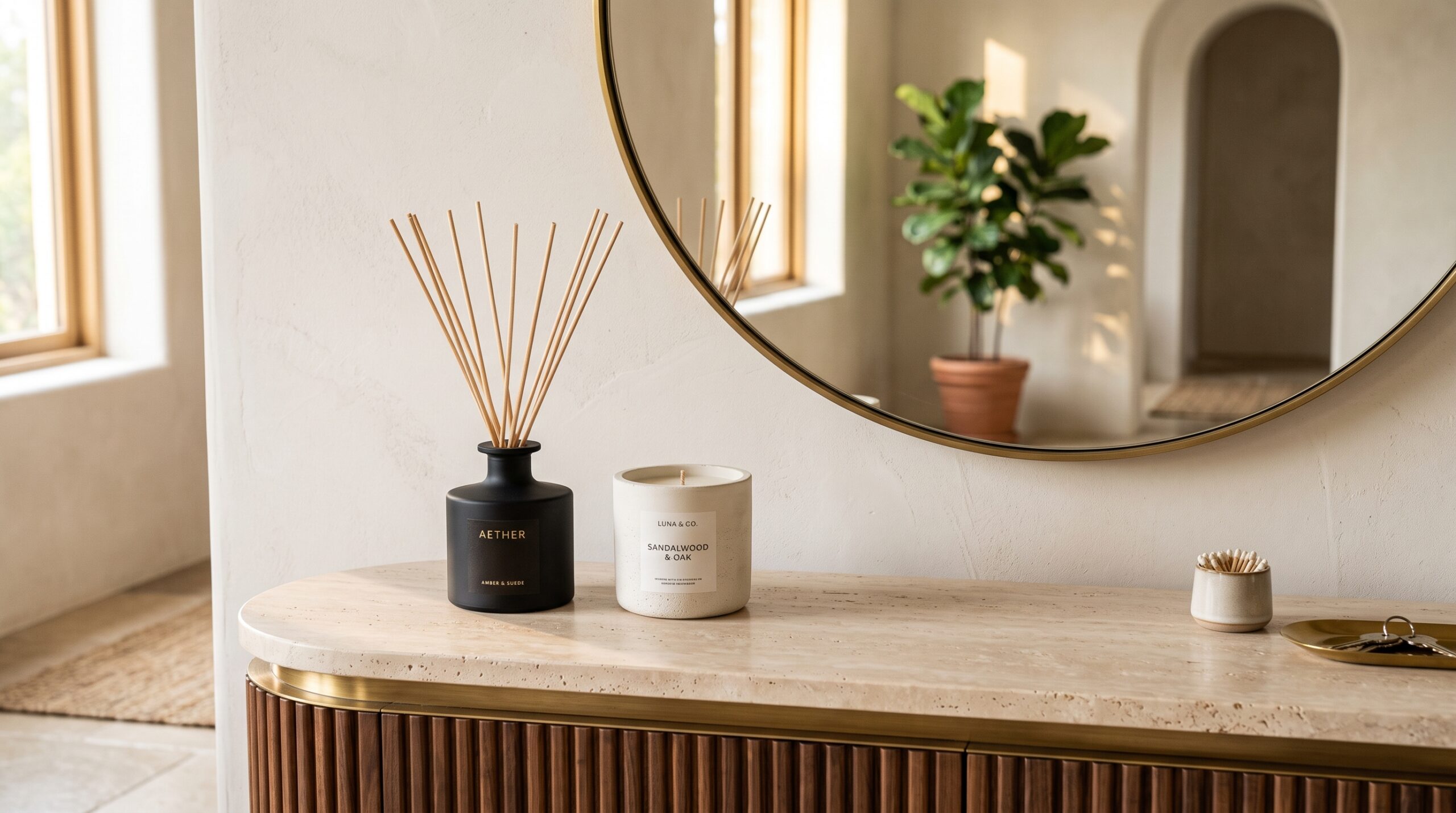
- Pair it with a reed diffuser in the same scent family — the diffuser maintains the base while the candle adds intensity
- Use a candle warmer — melts the entire top layer evenly and releases fragrance without burning the wick at all
Final Thoughts
A candle that doesn’t smell is almost never “broken” — it’s usually a burn time, placement, or wax issue that takes 2 minutes to fix. Start with the melt pool rule (1–2 hours minimum), trim your wick, and keep it away from moving air.
And if you’re ready to upgrade your home’s entire scent game — from candles to diffusers to full-room scent layering — explore our complete guide on how to make your home smell expensive.
Your home deserves to smell as good as it looks.
Found this helpful? Pin it for later and explore more scent guides at BespokeScenting.com